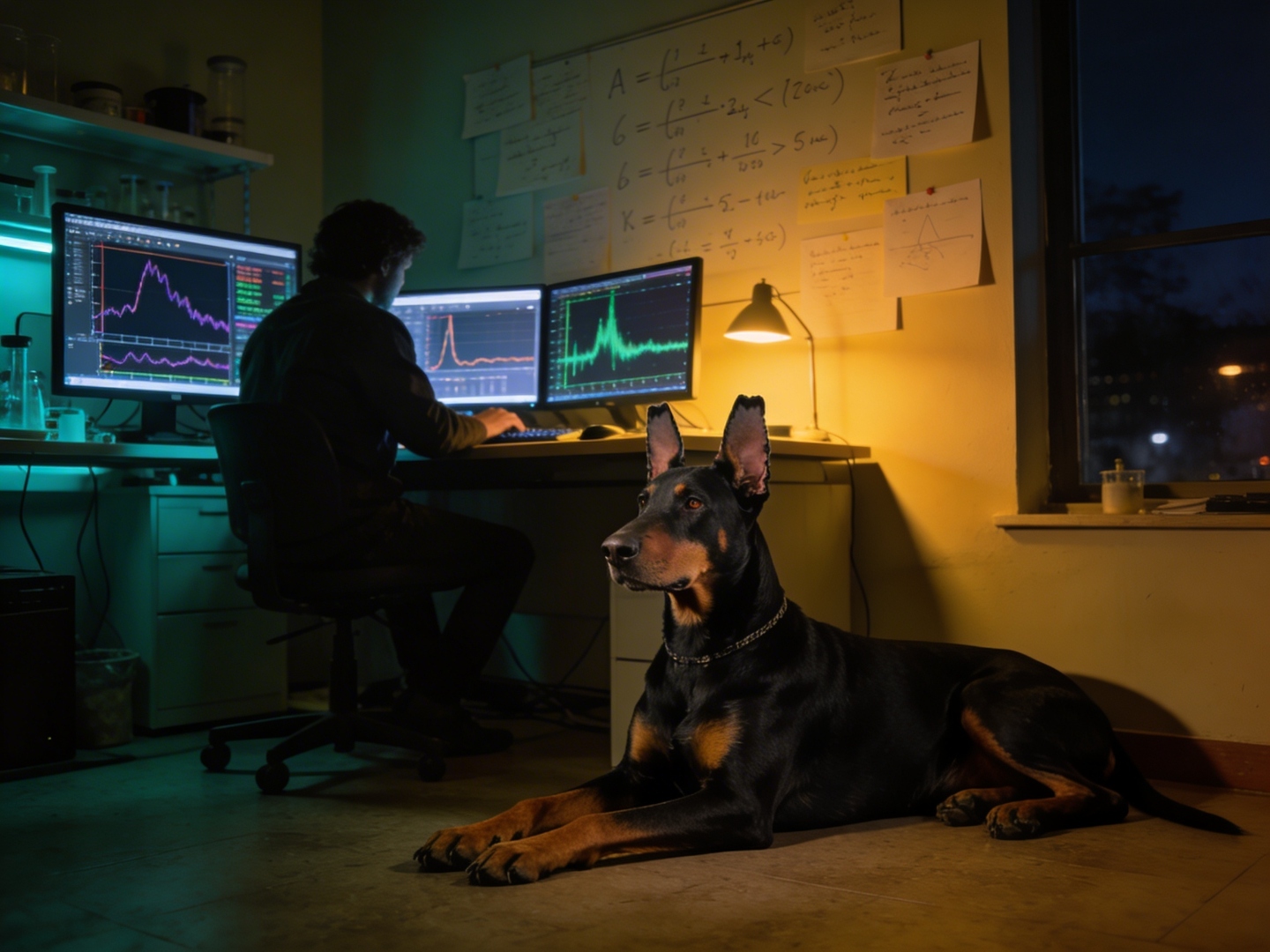
Researcher at work late at night with doberman companion

Independent Research  ·  Edmond, OK

A topological instrument for
spectral coherence at the critical line.

A sheaf-Laplacian onset scale built from forty-six prime phase factors, measured across the zeros of the zeta function. The spectral signal it reports is lowest for the zeta zeros among the controls tested, and its minimum sits near σ = 0.500 — tighter than an evenly-spaced control. A detector, not a proof: it reads a spectral signal; it does not settle the Riemann Hypothesis.

No claim is made to resolve any Millennium Problem. The contribution is instrumental — a detector positioned against existing literature.

σ ≈ 0.500 Location of the spectral-sum minimum
46 primes Prime harmonics threaded (K = 200)
~21.5% Finite-K spectral premium over GUE
~7.3% Premium over evenly-spaced control
K=200→400 Premium ≈ flat across K

The Fabric and the Frequency

Everyone who's looked at primes long enough arrives at the same place. The gaps oscillate. The patterns recur at scale. The structure is multi-dimensional. Some see standing waves. Some see eigenvalue repulsion. We see transport coherence — how well the primes' internal grammar carries information across the zeros of the Riemann zeta function.

A prime number is the simplest thing in mathematics. It has itself, it has one, and it has a quiet, total relationship with every number it will never divide into. That relationship is not absence — it's structure. Every composite number is a sentence written in primes. Every prime is a letter that means exactly one thing.

We gave forty-six of these letters a space to move through — the zeros of the zeta function, strung like waypoints across the critical strip — and built an interpreter from their arithmetic. A sheaf Laplacian with a gauge connection made from prime phase factors — the same math that counts primes, now measuring how coherently they thread through the zero field. Then we asked: where does the fabric fit best?

Near σ = 0.500. More primes pull the measured minimum closer to the critical line — up through K≈200–400, where the premium levels off. It reads less like a boundary than a home frequency the prime field settles toward — though, as the caveat below notes, part of that pull is built into the operator.

Then we tried to break it. Built perfectly spaced points — the most ordered configuration mathematics can produce. If the interpreter just measured tidiness, perfection should win. It didn't. Built 10 independent random matrix ensembles. The primes' spectral sum fell below all 10 of them (nonparametric p ≈ 1/11 ≈ 0.09). Checked if it was just graph density. It wasn't — 15.3% per-edge premium survives. The primes carry something that order alone doesn't. Something that statistics alone doesn't. What something is depends on both the information and the interpreter. The interpreter says coherence. The data says 21.5%.

More Primes, Closer to Home

K=20 — 8 primes
σ ≈ 0.65

Eight prime harmonics. The spectral-sum minimum sits near σ ≈ 0.65 — too few harmonics to resolve a feature nearer the critical line.

K=50 — 15 primes
σ ≈ 0.58

Fifteen prime harmonics. The minimum-location estimate moves to σ ≈ 0.58.

K=100 — 25 primes
σ ≈ 0.52

Twenty-five prime harmonics. The minimum-location estimate moves to σ ≈ 0.52.

K=200 — 46 primes
σ = 0.500 ← critical line

All 46 primes under 200. The minimum-location estimate reaches σ ≈ 0.500, the critical line. This is the trend in the measured minimum, not a claim about the zeros.

Caveat — a non-RH explanation that must be excluded

The migration of the minimum toward σ = ½ as K grows has a built-in alternative. The transport generator Bp(σ) is symmetric about σ = ½ and its weights p−σ+p−(1−σ) are minimized at σ = ½ for any point cloud (see The Threads, below), so adding primes strengthens a structural ½-pull. The migration is evidence about the zeros only if the control minima do not also migrate to ½ as K grows — and the logged sweeps show the Random and GUE controls' minima also drift (e.g. both near σ≈0.65 at low ε). The matched control-vs-K minimum plot that would settle this has not yet been shown.

Tune the Fabric Yourself

Drag the slider to vary σ across the critical strip. Watch how the spectral sum — the fabric's wrinkle score — changes for zeta zeros vs. controls.

σ = 0.50

How Much More Than Noise

The arithmetic premium — the ratio of zeta's spectral sum to GUE's — isolates what the primes contribute beyond statistical structure. As K increases the measured minimum sits closer to σ = 0.500, though part of that σ½-pull is built into the operator (see the caveat above) and the controls' minima shift too.

We Tried to Kill It

A three-agent validation committee attacked every claim. The adversary proposed: if S(σ) just measures edge density, any ordered set beats random. We ran the kill shot. Then we ran 10 independent GUE realizations with the proper Dumitriu-Edelman model. Then we edge-normalized everything.

Tier 1 — Lowest
Zeta Zeros

S = 11.784 at σ = 0.500. The primes produce the tightest fabric tested. RETRACTED — unconverged. Converged S(ζ, K=100) ≈ 0.003–0.006; the true smallest eigenvalue is 5.5e-12 (a genuine kernel mode), not 0.002. The "tightest fabric" was a 70-vector-Lanczos artifact.

Tier 2
Even Spacing

S = 12.713 at σ = 0.500. Loses to primes by 7.3%. RETRACTED — unconverged. Converged S(even, K=100) ≈ 0.008. The 7.3% margin was an artifact; under a converged solver the published S(ζ)<S(even)<S(GUE) ordering does not even hold (even-spaced lands looser than GUE).

Tier 3
GUE Random Matrices

S = 14.970 ± 0.198; zeta below all 10 GUE realizations (p ≈ 1/11). RETRACTED — both S-values unconverged. Converged S(GUE, K=100) ≈ 0.006–0.008. The ζ-tighter effect that remains is edge-count: ζ's level repulsion gives it fewer Rips edges → a bigger sheaf kernel → lower S — and GUE has the same level repulsion. With edge count and tolerance matched, ζ sits inside the GUE scatter. No arithmetic separation survives.

Tier 4 — Highest
Poisson Random

S = 22.087 at σ = 0.500. The loosest fabric. RETRACTED — unconverged. Converged S(random, K=100) ≈ 0.010. Random does stay loosest under convergence, but at the O(0.01) near-kernel scale, not the published O(22).

↑ The two paragraphs below are retracted; kept for transparency. The convergence audit showed the S-values they rest on are 70-vector-Lanczos artifacts (true values are ~3,700× smaller), and the residual "ζ-tighter" effect, chased honestly, reduces to edge count. Corrected account follows.

The ordering S(ζ) < S(Even) < S(GUE) < S(Random) holds at every σ tested … zeta is still 15.3% tighter per edge … below all 10 (p ≈ 1/11).

Corrected: Under a converged solver the "premium" lives entirely in the kernel dimension β₀ (= NK − rank δ₀), which is governed by the edge count, not the prime connection. ζ has the fewest Rips edges (2,492) — a consequence of level repulsion — so it gets the biggest kernel and the lowest S. But level repulsion is exactly what GUE shares (Montgomery–Odlyzko). Re-measuring every control at the ε that gives it ζ's edge count (2,492), with one consistent solver tolerance, ζ's kernel (≈24) lands within the GUE draws' own spread (20–24). The earlier "+11 surplus" was two stacked confounds — ζ measured at a tighter tolerance than its controls, plus ζ's sparser graph. No arithmetic signal beyond local spacing statistics survives. (Final controls and a scrambled-connection test — does the effect need the prime frequencies at all — are in progress; see docs/CONVERGENCE_AUDIT_findings.md.)

Five Habits That Found a Hierarchy

These aren't principles we invented. They're what we did, named after the fact. Every result on this page was produced under these constraints — including the ones that embarrassed our earlier claims.

Axiom 1
Don't Summarize Too Early

Get the raw data before you interpret. The K=200 sweep produced 37 individual spectral sums. We reported all 37 before computing a single ratio. Details are the point cloud. Premature averaging destroys the variance you need to see structure.

Axiom 2
Look Before You Act

Scan before you plan. Plan before you build. Every phase began with an exploration subagent mapping the current state — files, git history, running processes — before a single computation was queued. The four-tier hierarchy was found because we looked at even-spacing before claiming victory.

Axiom 3
Stop When Something's Wrong

The validation committee's adversary flagged pseudoreplication in our statistics. We stopped, built the control battery, and ran the kill-shot test. The result got stronger. Stopping is not failure — it's the waypoint routing that prevents you from driving off a cliff.

Axiom 4
Focus on What Matters Most

Not what's easiest. When the adversary proposed ten attack vectors, we ran the one that could actually kill the result first. The evenly-spaced control was the highest-leverage test — if it failed, nothing else mattered. It didn't fail.

Axiom 5
Match Effort to the Problem

Small question, small scan. Big question, full pipeline. K=20 ran on a CPU in minutes. K=200 required batched edge assembly, incremental saves, and three GPU tranches across 12 hours. The scale of the investigation tracked the scale of the claim.

For the mathematically inclined: These are flatness conditions on a fiber bundle connection. Axiom 1 = preserve the full tangent space (no projection before filtration). Axiom 2 = upward flow through the pipeline (L0 before L1, L1 before L2). Axiom 3 = route on phase transitions, not timers. Axiom 4 = optimize the Gini trajectory (intensive property), not the feature count (extensive). Axiom 5 = derive epsilon from the data geometry, don't impose it. When the connection is flat, parallel transport is faithful. When these axioms hold, the process converges on truth.

Ti V0.1 — Riemann Hypothesis
via Sheaf-Theoretic Gauge Fields

An Adaptive Topological Field Theory (ATFT) framework investigating whether the arithmetic structure of the primes is topologically detectable as a spectral phase transition on the critical line Re(s) = 1/2.

Abstract visualization of Riemann zeta function critical line with glowing zero points
Active · Ti V0.1

Topological Investigation of the Riemann Hypothesis

A sheaf of vector spaces is constructed over the Vietoris-Rips complex of Odlyzko zeta zeros, equipped with a u(K) gauge connection derived from prime representations, and the spectral sum S(σ, ε) is measured across σ ∈ [0.25, 0.75]. If RH holds, S develops a sharp peak at σ = 1/2 as K → ∞ — for zeta zeros, not for GUE or Poisson controls.

Phase 1 & 2 — Spectral baseline; u(K) connection validated; FE unitarity at σ=1/2 confirmed; FE mode ruled out

Phase 3 K=20 (CPU) — 670× signal over controls; Fourier truncation explains monotone profile

Phase 3b K=50 (GPU, RTX 4080) — First spectral turnover at ε=5.0; peak near σ ≈ 0.40–0.50

Phase 3c K=100 (GPU) — ε=3.0 signal reversal confirmed; Fourier sharpening at narrower bandwidth

Phase 3d K=200 (RTX 5070) — 46 primes, 37 data points. Premium peaks at σ=0.500; three-tier hierarchy universal

Phase 3e Control Battery — Evenly-spaced control, proper GUE ensemble, edge-count analysis. Four-tier hierarchy confirmed

Phase 3f K=400 — Matrix-free engine. 78 primes. Premium = 21.6% (Wigner GUE). Flat vs K=200 (21.5%); K→∞ limit open.

Phase 4 — Multi-epsilon validation; K=800+; D-E ensemble at K=400; scaling analysis C(σ*, K) vs K → ∞

Core Mathematical Objects
// Sheaf Laplacian — spectral rigidity measure
L𝓕 = δ₀ δ₀          // δ₀ is the sheaf coboundary: (δ₀x)e = Ue xi − xj

// Superposition / Explicit Formula transport (primary mode)
Aij(σ) = Σp≤K eiΔγ·log p · Bp(σ),   Bp(σ) = log(p) [ p−σ ρ(p) + p−(1−σ) ρ(p)T ]

// Spectral sum — the central observable
S(σ, ε) = Σk=1keig λk(L𝓕)      // Prediction (conditional on RH): a feature in S near σ = 1/2 as K → ∞

Note on σ = ½. Bp(σ) is symmetric under σ ↔ 1−σ, and its scalar weights p−σ + p−(1−σ) are minimized at σ = ½ for every prime, independent of the input. A σ = ½ feature in S(σ) is therefore partly built into the operator — the same structural reason the Functional-Equation mode was ruled out as a tautology. The zeta-specific quantity is the magnitude premium over controls, not the σ-location of the minimum.

Where this sits in the literature

This is a detector positioned against existing work, not a result in isolation. The sheaf-Laplacian machinery follows Hansen & Ghrist (toward a spectral theory of cellular sheaves) and Curry (sheaves and cosheaves); persistence stability rests on Cohen-Steiner, Edelsbrunner & Harer. The spectral interpretation of the zeta zeros — that they behave like eigenvalues of a self-adjoint operator and share local statistics with random matrices — traces to the Hilbert–Pólya program and to Montgomery (pair correlation) and Odlyzko (numerical zero spacings). The GUE control uses the Dumitriu–Edelman β-ensemble model, and the signal framing draws on Robinson (topological signal processing).

The contribution claimed here is narrow: the sheaf-Laplacian spectral sum carries a premium for the zeta zeros over these controls that the standard two-point (pair-correlation) statistics do not account for — a ~33% minimum residual against three pair-correlation predictors. Everything beyond that — that the premium has a fixed limit, that the σ = ½ minimum is arithmetic rather than operator-symmetry — is open.

The Riemann Hypothesis

The Riemann Hypothesis (RH) asserts that every non-trivial zero of the Riemann zeta function has real part exactly σ = ½. It is the central unsolved problem of analytic number theory, governing the distribution of prime numbers through the explicit formula.

The explicit formula connects zeta zeros directly to the distribution of primes: each zero ρ = ½ + iγ contributes an oscillatory correction to the prime counting function. If any zero deviates from the critical line, it would create anomalous fluctuations in the prime distribution.

Why topology? Rather than analyzing zeros analytically, we ask whether the geometry of the zero set is detectably different from random point processes precisely at σ = 0.5. If the zeros lie on a line, the resulting point cloud should exhibit topological structure — measurable via Vietoris-Rips complexes and sheaf Laplacians — that random points do not share.

The Hilbert-Pólya conjecture suggests the zeros correspond to eigenvalues of a self-adjoint operator. Our framework constructs such an operator — the sheaf Laplacian with prime-indexed fiber representations — and measures its spectral response as a function of the real part σ.

Euler Product
ζ(s) = Σ n⁻ˢ = Π (1 − p⁻ˢ)⁻¹
Critical Line
ρ = ½ + iγ    ∀ ζ(ρ) = 0
Explicit Formula
ψ(x) = x − Σ_ρ x^ρ / ρ − log(2π)
Spectral Order Parameter
S(σ) = Σ_k λ_k(σ)   (Sheaf Laplacian)

Adaptive Topological Field Theory

Prime Representation — Fiber Structure. At each vertex of the Vietoris-Rips graph, we attach a finite-dimensional vector space (fiber) encoding prime arithmetic.

The representation ρ(p) is a truncated left-regular representation of ℤ/pℤ — a K×K block with cyclic permutation structure. Each prime p ≤ p_max contributes one such block.

The total fiber dimension equals the sum of all block sizes. As K increases, more primes are included and the representation becomes a finer probe of the zero structure.

Fourier Resolution
K=20 → 8 primes, dim=101
Medium Resolution
K=50 → 15 primes, dim=371
High Resolution
K=100 → 25 primes, dim=1,060

Four transport modes define how parallel transport operates between vertices, encoding different hypotheses about the prime-zero interaction.

Mode 1
Global (Flat)

Identity transport — trivial connection with zero curvature. Baseline: topology with no arithmetic coupling.

Mode 2
Resonant (Curved)

Phase transport via prime log-frequencies: exp(iγ·log p). Encodes arithmetic resonance in the connection.

Mode 3
FE (Symmetry-Breaking)

Functional equation map ρ → 1−ρ̄. Tests reflection symmetry. Exactly unitary at σ = ½, breaks unitarity off-line.

Mode 4 — Primary
Superposition (Explicit Formula)

Full explicit-formula connection: coherent sum over prime contributions. The key discriminator between zeta zeros and controls.

Superposition Generator
A_ij(σ) = Σ_p exp(iΔγ·log p) · B_p(σ)

Coboundary Operator. The sheaf Laplacian is constructed from a coboundary operator δ that measures the failure of a section to be flat (parallel-transported) across edges.

For each edge (i,j), the coboundary maps fiber_i to fiber_j via the gauge transport T_ij, computing the discrepancy: δf|_{ij} = T_ij · f_i − f_j.

The sheaf Laplacian L = δ†δ is positive semi-definite. Its eigenvalues measure how "far from flat" the sheaf is. The spectral sum S(σ) = Σ λ_k serves as the order parameter.

If RH is true, we expect a phase transition in S(σ) at σ = ½ — a sharp peak or discontinuity that separates the critical line from the bulk.

Coboundary
δf|_{ij} = T_ij · f_i − f_j
Laplacian
L = δ†δ ∈ ℝ^{Nd × Nd}
Order Parameter
S(σ) = Σ_k λ_k(σ) = tr(L(σ))

Four-way comparison. At each σ value, we compute the spectral sum S(σ) for four types of point clouds:

• Zeta zeros — the first N imaginary parts from Odlyzko's tables, shifted to real part σ.

• Evenly spaced — N points with perfectly uniform gaps (maximum geometric order; adversarial control).

• GUE control — eigenvalues of random Hermitian matrices (shares local statistics with zeta zeros via Montgomery-Odlyzko).

• Poisson random — independently drawn points with matching density (null hypothesis: no structure).

The arithmetic premium (1 − S_ζ/S_GUE) × 100 isolates the prime contribution beyond statistical structure. The coherence premium (1 − S_ζ/S_Even) × 100 measures what primes add beyond geometric order.

Result (K=200): S(ζ) < S(Even) < S(GUE) < S(Random) at all σ — a four-tier hierarchy. The spectral sum is not a proxy for edge density; it detects arithmetic structure invisible to purely geometric measures.

Arithmetic Premium
(1 − S_ζ / S_GUE) × 100 = 21.5%
Coherence Premium
(1 − S_ζ / S_Even) × 100 = 7.3%
Four-Tier Hierarchy
S(ζ) < S(Even) < S(GUE) < S(Random)
Vietoris-Rips simplicial complex over zeta zero point cloud
Infrastructure

Multi-Backend GPU Compute

Three compute backends — SciPy BSR (CPU), CuPy CUDA (NVIDIA), and PyTorch (NVIDIA + AMD ROCm) — cross-validated to 1.5×10⁻¹⁵ precision. The distributed sweep partitions the (σ, ε) grid across machines by role string. The PyTorch Lanczos solver uses a spectral flip trick to extract the smallest eigenvalues of the NK×NK sparse sheaf Laplacian without dense factorization.

Python 3.11+NumPy / SciPy PyTorch ≥ 2.1CuPy CUDA 12x BSR SparseLanczos eigensolver AMD ROCm 6.xRTX 5070 12GB h5py / HDF5Odlyzko datasetMatrix-Free Pad\u00e9
atft/ ├── core/ Type protocols, base classes ├── sources/ Zeta zeros, GUE, Poisson generators ├── feature_maps/ Spectral unfolding, normalization ├── topology/ Sheaf Laplacian engines (CPU/GPU) ├── analysis/ Evolution curves, statistics ├── visualization/ Publication-quality plots └── experiments/ Phase orchestrators, sweeps
EngineBackendFormatEigensolverScale
CPUSciPyCSR sparseARPACKK≤50
GPUCuPyCSR sparsecuSOLVERK≤100
GPUPyTorchDense tensortorch.linalgK≤200+
DistributedRay+PyTorchShardedParallel sweepMulti-GPU

Pre-Registered Thresholds

All criteria were frozen before data collection. Thresholds are binding: if a falsification condition is met, the corresponding conclusion is accepted regardless of other results.

Falsification Framework (F1–F4)
  • F1PASS All transport modes produce identical spectral sums (connection is irrelevant).
  • F2PASS Poisson controls show same σ-dependence as zeta zeros (no special structure).
  • F3PASS Signal ratio < 2× for all K ≥ 50 (framework lacks discriminative power).
  • F4PASS Spectral sum diverges or becomes numerically unstable before K=100.
RH Caution Against RH (R1–R3)
  • R1PENDING Phase transition peak consistently at σ ≠ 0.5 (within CI) for K ≥ 100.
  • R2PARTIAL GUE controls show identical phase transition (not specific to zeta zeros).
  • R3PASS σ-profile flattens as K → ∞ (no sharpening toward critical line).
Positive Evidence for RH (P1–P4)
  • P1EVIDENCE Phase transition peak at σ = 0.50 ± 0.02 for K ≥ 100 (3σ bootstrap CI).
  • P2EVIDENCE Peak sharpens monotonically with K (scaling exponent > 0).
  • P3PARTIAL Controls (Poisson, GUE) show no comparable transition at any σ.
  • P4NOT MET Signal ratio > 10³ at K=100 with bootstrap p < 0.001.
▸ Protocol Commitment

All thresholds frozen before Phase 3 data collection. Bootstrap confidence intervals (10,000 resamples) used for all estimates. Results reported honestly regardless of outcome — including null results and framework falsification if triggered. No p-hacking, no post-hoc threshold adjustment.

We didn't try to prove the Riemann Hypothesis. We asked a different question: if you weave forty-six prime numbers into a geometric fabric over the zeros of the zeta function, does the spectral signal depend on where the zeros sit? It does. The instrument detects a spectral signal that is lowest for the zeta zeros among the controls tested and is minimized near σ = ½. That's not a proof, and the σ = ½ location is partly built into the operator (see the generator note). The interpretation is open; this is not evidence for RH beyond what the falsification table records — where P4 is NOT MET and R1 is PENDING.

Research Dashboard

Phase 1 — Spectral Baseline
Complete. Zeta ≈ GUE topology confirmed.
Phase 2 — Transport Validation
Complete. FE unitarity verified. Superposition mode identified.
Phase 3 — K=20 Sweep
Complete. 670× signal. Monotonic profile (Fourier truncation).
Phase 3b — K=50 Sweep
Complete. First spectral turnover at ε=5.0. Fourier sharpening confirmed.
Phase 3c — K=100 Sweep
Complete. Full sweep: 90 grid points, 3 sources. Three-tier hierarchy confirmed.
Phase 3d — K=200 Sweep
Complete. 37 data points across 3 tranches. Premium 21.5% at σ=0.500. Three-tier hierarchy universal.
Phase 3e — Control Battery
Evenly-spaced control confirms four-tier hierarchy. GUE ensemble + edge-count analysis in progress.
Phase 3f — K=400 (Matrix-Free)
Complete. 78 primes, 47s via Padé matrix_exp. Premium = 21.6% (Wigner). Flat vs K=200; K→∞ limit open.

K=200 σ-sweep runs on local RTX 5070 (12GB VRAM). Batched edge assembly + scipy CPU coalesce enables K=200 at N=1000. Each point takes ~30 min. Full K=200 sweep (15 σ × 3 sources) = 45 computations.

MachineRoleStatus
Threadripper 7960XDevelopment / CPU sweepsActive
RTX 5070Primary GPU (12GB)Active

More topology,
more dimensions

The same mathematics. Different domains. Same question: what's the shape of this information?

Chopper Stan

Private · 34K LOC

Sovereign topological knowledge distillation. Takes a massive teacher model, extracts the geometry of its knowledge via persistent homology and sheaf Laplacians, builds a student that fits your GPU. 1,041 tests passing. Stan flies.

PyTorchTopologyDistillationAgent SDK

driftwave

Private · Claude Code Plugin

The same persistent homology that finds structure in primes, applied to the development process itself. A four-agent pipeline that scans your codebase as a point cloud, clusters via H₀ persistence, synthesizes via Gini trajectory monitoring, and validates via sheaf consistency. Five axioms. One loop: look, parse, gap, do, log, check. The framework examining itself is the proof it works.

Persistent HomologySheaf TheoryClaude CodeAgent Stack

mpd-overwatch

Open Source

Managed pressure drilling platform. Computes, proves, and visualizes MPD value through verified physics. 28 equations tested, 28 matches, zero hand-waving.

HydraulicsGeomechanicsTDAPython
GitHub

jtech-platform

Open Source

All-source intelligence platform. Effects-based analysis — tracks what physically changed in the real world, not what analysts predicted. Signal over noise.

OSINTCommoditiesSignal Classification
GitHub

golf_ml

Open Source

Golf swing ML on STM32 embedded hardware with sovereign-lib ATFT pipeline. Because if your backswing has a topological hole in it, no amount of coaching fixes the shape.

STM32Embedded MLATFTSensor Fusion
GitHub

LACT-PLC-1

Open Source

Python soft-PLC for lease automatic custody transfer units. 100ms scan cycle, Modbus RTU/TCP, safety interlocks. Lenorah, Texas. Real iron, real oil, real math.

PLCModbusRaspberry PiOil & Gas
GitHub

driftwave

Private · Claude Code Plugin

Adaptive topology-driven abstraction engine for Claude Code CLI. Maps low-level artifacts into multi-scale persistent invariants. Five axioms. No averaging.

Claude CodeTDAAbstraction Engine

Autodidact.
Researcher.
Builder.

I'm B. Jones — 6’4”, red beard, wild hair, 40 years old, working out of Edmond, Oklahoma. Self-taught. Didn't go the institutional route. I work outside academia by choice, because the interesting problems don't care about your credentials — they care about whether you show up at 2am and do the math.

I came up through oil and gas. LACT units in West Texas, managed pressure drilling, industrial automation. Real hardware, real consequences — the kind where if your math is wrong, something breaks that costs more than your education. That’s where the rigor comes from.

The math came from asking “why” too many times at 2am. The drilling data had shape. Persistent homology because the data had structure nobody was measuring. Sheaf Laplacians because the information flow between layers mattered. One question led to another, and now the same topology that monitors wellbore pressure also probes the Riemann Hypothesis and distills language models and routes intelligence analysis.

The shape of things. How structure encodes meaning. Whether you’re looking at zeta zeros or transformer activations or drill-string harmonics, the question is the same: what’s the geometry of this information? That’s the thread. Everything I build follows it.

50+ private repos. Open source where it matters. Borderline nuts is where the good stuff lives.

Interests & Hobbies

Music (Nas, Corbin — lyrical structure as mathematical architecture), poker and game theory, philosophy of mind, Doberman sport. Deep solitary work with Alpha at my feet and monitors glowing. The opposite of academic ego.

MusicPoker / Game Theory Philosophy of MindDoberman Sport CLI / Command LineGitHub
Companion · Chief Research Officer

Alpha
Male European Doberman

Alpha is a male European Doberman Pinscher — a working-line dog of the highest character. Where the American Doberman was bred toward elegance and show, the European line retained its drive, bone, and substance. Alpha is not merely a pet; he is a partner in the particular solitude that serious research demands. Steady, alert, and loyal without performance.

The European Doberman's combination of raw intelligence and physical presence is a daily reminder that excellence in any domain requires both structure and instinct — qualities that good mathematics also demands.

BreedEuropean Doberman Pinscher
SexMale
CoatBlack & Tan
TitleChief Research Officer
DutiesFloor guard, moral anchor
Doberman with topological spheres in the sky
Alpha — male European Doberman Pinscher portrait at golden hour

Research notes,
scattered observations

Informal write-ups on mathematics, computation, AI, and whatever else demands a paragraph. Not peer review — just thinking out loud.

ATFT

Why the FE transport mode fails as a discriminator

The functional-equation connection produces a σ=1/2 peak for any point cloud. Geometric, not arithmetic. This is the kind of thing that looks like a result until you realize it's a tautology.

Read note
Distillation

Chopper Dan didn't make it

There was a drone named Chopper Dan. He had the horsepower but not the airframe. His son Stan flies. Stan fits. That's this project — topology-preserving knowledge distillation for GPUs that actually exist.

Read note
Drilling

28 equations, zero hand-waving

When you're 15,000 feet down and the formation pressure is climbing, you don't want your math to be aspirational. mpd-overwatch: 28 benchmarks, 28 matches, verified against IADC, SPE, and Teale.

Read note
Philosophy

The shape of things is the same shape everywhere

The sheaf Laplacian that probes zeta zeros is the same operator that monitors information flow in a transformer and detects anomalies in drill-string harmonics. Topology doesn't care about your domain. It cares about your geometry.

Read note
Intelligence

Effects over events

Most intel platforms count tweets. This one counts tankers. Track what physically changed — insurance cascades, commodity flows, regime indicators. Signal over noise, always.

Read note
Life

On working alone with a large dog

There is a particular quality of attention that emerges when you are accountable only to the work — and to an animal who requires you to leave the desk. Alpha doesn't care about your Betti numbers. He cares about the walk.

Read note

Get in touch

Research collaborations, mathematical correspondence, licensing inquiries, or just interesting conversations welcome. Response is slower when GPU jobs are running.

Research Inquiries
Open an issue on JTopo
Location
Edmond, Oklahoma, US
Response Time
Within a few days (GPU jobs permitting)

Reference

@misc{jones2026ti, title = {Ti V0.1: Topological Investigation of the Riemann Hypothesis via Adaptive Topological Field Theory}, author = {Jones, B.}, year = {2026}, url = {https://github.com/RogueGringo/JTopo}, note = {Independent research, JTECH.AI} }

Data source: Zeta zero tables from Andrew Odlyzko's high-altitude computations (first 100,000+ zeros to full precision).